Think Tank Lanka launches inaugural issue of Think Tank Journal
October 23, 2026 · Admin · News
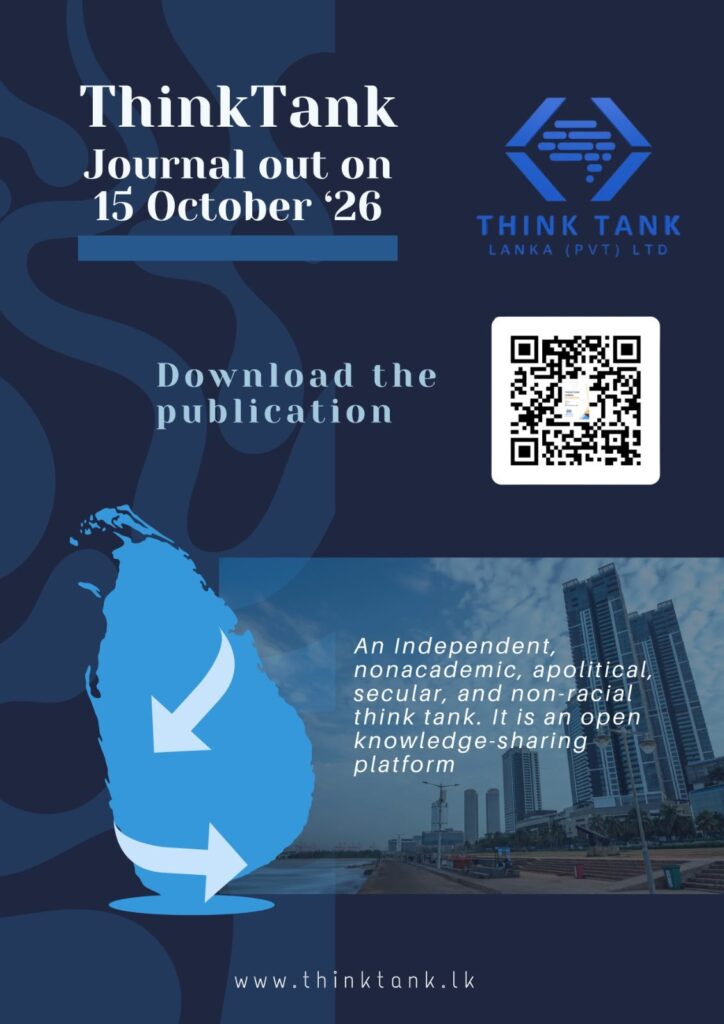
Five policy papers offer practical, research-based recommendations to support Sri Lanka’s national development strategies and economic resilience.
Think Tank Lanka (Pvt) Ltd launched the inaugural issue of the Think Tank Journal (Volume I, Issue 1, 15 October 2026), presenting research-based policy recommendations aimed at addressing key challenges in Sri Lanka’s economic development, governance and human capital.
The journal is an independent, non-academic, apolitical, secular and non-racial open knowledge-sharing platform that seeks to bridge the gap between empirical research and national strategic policymaking. Its inaugural issue focuses on practical solutions that could inform national development strategies, strengthen domestic capabilities and support a more resilient and self-reliant economy.
The five policy papers in the inaugural issue cover red seaweed cultivation and the blue economy, climate-smart agriculture, regenerative tourism, educational reform and evidence-based lawmaking. Together, they examine how research findings can be translated into practical policy frameworks to address development challenges and improve the use of national resources.
The paper on blue-economy aquaculture and seaweed cultivation, by independent consultant Sivaram Kulendran, presents a roadmap for expanding Sri Lanka’s red seaweed industry, with a target of reaching annual production of 25,000 tonnes by 2030. It examines the sector’s export potential and its capacity to generate livelihoods, particularly for women in coastal communities.
Research by Bandula Weerasingha of the Agromart Outreach Foundation explores how strengthening grassroots Farmer Organisations can improve agricultural productivity and resilience. Drawing on a six-year study covering smallholders in Hambantota and Kegalle, the paper highlights the potential of climate-smart agricultural practices and community-based resource management.
In the tourism sector, destination specialist Manoj Silva proposes a regenerative tourism framework that places greater emphasis on local community participation, economic value and environmental conservation. The paper examines the challenges associated with prioritising visitor numbers over tourism earnings and presents alternatives aimed at ensuring that tourism benefits local communities and ecosystems.
Management consultant Roshanga Wickremesinghe examines the need to modernise education and literacy frameworks to prepare Sri Lanka’s workforce for changing economic and technological demands. The paper advocates international benchmarking through the OECD’s Programme for International Student Assessment (PISA) and the development of a national Adult Learning and Education framework.
The fifth paper, by policy analyst Gajamugavaranan Ganesalingam, focuses on regulatory governance and evidence-based lawmaking. It proposes institutionalising Regulatory Impact Assessments and examines the challenges surrounding post-enactment reviews of legislation, with the aim of strengthening the quality and accountability of public policymaking.
The inaugural issue underscores the importance of moving beyond theoretical analysis towards practical, evidence-informed approaches to national development. By examining policy options across agriculture, tourism, aquaculture, education and governance, the journal seeks to contribute to informed public discussion and provide useful insights for policymakers, researchers, development practitioners and other stakeholders.
Volume I, Issue 1 is available through the Think Tank Lanka publications portal at https://thinktank.lk/publications/. Think Tank Lanka (Pvt) Ltd is an independent, non-academic, apolitical, secular and non-racial think tank and open knowledge-sharing platform headquartered in Nugegoda, Sri Lanka. It aims to facilitate knowledge-sharing and contribute research-based perspectives to national policy discussions.